
Sector Area Calculator
Sector Area Calculator
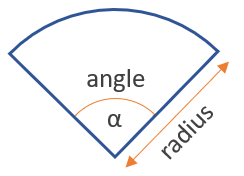
A circular sector is a portion of a circle bounded by two radii and the arc between them. The size of a sector depends on two values: the radius of the circle and the central angle that defines the slice of the circle.
The Sector Area Calculator above determines the area of a circular sector using the radius and the angle. The radius can be entered in different measurement units such as meters, kilometers, centimeters, feet, yards, inches, or miles. The angle can be provided either in degrees or radians.
When different units are used, the calculator automatically converts the values so the result remains accurate.
Sector Area Formula
The formula used to calculate the area of a sector depends on whether the angle is expressed in degrees or radians.
Sector Area Formula (Degrees)
When the angle is measured in degrees:
Area = (A × π × r²) / 360
Where:
- A = central angle in degrees
- r = radius of the circle
- π ≈ 3.14159265358979
This formula works because a full circle contains 360 degrees, so the sector represents a fraction of the circle’s total area.
Sector Area Formula (Radians)
When the angle is measured in radians:
Area = (A × r²) / 2
Where:
- A = angle in radians
- r = radius
Since a full circle contains 2π radians, the sector area becomes a proportional fraction of the circle’s area.
Example Calculation (Degrees)
Suppose the following values are given:
Radius = 30 meters
Angle = 90°
Step 1 – Apply the formula:
Area = (A × π × r²) / 360
Step 2 – Substitute the values:
Area = (90 × π × 30²) / 360
Step 3 – Simplify:
Area = 225π
Step 4 – Convert to decimal:
Area ≈ 706.8583470577 m²
Therefore, the sector covers approximately 706.86 square meters.
Sector Geometry Explained
A circular sector represents a fraction of a circle’s total area. If the central angle is small, the sector covers a smaller portion of the circle. As the angle increases, the sector area increases proportionally.
Key components of a sector include:
- Radius (r) – distance from the center to the arc
- Central Angle (A) – angle formed by the two radii
- Arc – curved boundary of the sector
These elements together determine the size of the sector.
Applications of Sector Area
Circular sectors appear in many practical applications, including:
- Engineering and mechanical design
- Architecture and structural layouts
- Navigation and radar coverage calculations
- Agriculture and land measurement
- Pie chart data visualization
Understanding how to calculate the area of a sector is therefore useful in both mathematics and real-world applications.
Related Geometry Calculators
You may also find these calculators useful:
- Circle Area Calculator
- Triangle Area Calculator
- Rectangle Area Calculator
- Trapezoid Area Calculator
- Ellipse Area Calculator
- Parallelogram Area Calculator
These tools help determine the area of other common geometric shapes quickly and accurately.
People Also Ask
What is the formula for the area of a sector?
The area of a sector can be calculated using (A × π × r²) / 360 when the angle is measured in degrees, or (A × r²) / 2 when the angle is measured in radians.
What is a sector in geometry?
A sector is a portion of a circle defined by two radii and the arc between them.
Why are two formulas used for sector area?
The formula changes depending on whether the angle is expressed in degrees or radians.